BUSINESS PREMISE
Our prime operational goal is the creation of a synergistic organization of farmers, certified seed processors, manufacturers, and consumers, centered upon the production of Cannabinoids “CBD” from genetically advantaged CBD premium quality hemp plants. Our preferred style of growing Cannabis, known as “Sinsemilla” or without seeds, is the way that illicit marijuana has been traditionally cultivated, in order to maximize the production of Cannabinoids in the plant. The higher quality CBD strains are typically hybrid crosses of Hemp and Marijuana that are chosen for flower production, so they grow squatter, and less lanky, with less stalk production along with the high percentage CBD trait.
This is a new approach to growing hemp, where the plant is being grown for CBD production, and not pulp and seed base. As modern science uncovers the applications for Cannabinoids such as CBD, as a genetic breeder GPSI is taking a scientific look at Hemp genetics and creating High CBD hybrids that are low in THC. We take high CBD Hemp strains and mix them with traditional Marijuana strains to increase things like flower production, density, structure, and come out with new strains that have all the properties of a medical Marijuana strain, but low enough THC levels to be classified as industrial Hemp.
Regulatory agencies are rapidly moving to a clearly defined line as to what is considered Hemp and what is considered Marijuana in the U.S., as well as the increase in our awareness of other non-scheduled Cannabinoids such as Cannabidiol, we will see rapid advances in breeding and hybridization that will see the country looking at Hemp in an entirely different light than it has been viewed in most of our lifetimes, and that is as not only an unbelievable renewable resource in terms of pulp and fiber applications, but also as an important source of fully legal beneficial Cannabinoids such as CBD.
INDIGENOUS MEDICINAL BENEFITS OF OUR PRODUCT: CBD OIL
Our prime operational goal is the production, processing and distribution of Cannabinoids “CBD” from genetically advantaged CBD premium quality hemp plants. Cannabinoids already exist in our body naturally as part of the endocannabinoid system, which handles many different functions including appetite, pain, sleep, mood, sex drive, stress levels, and hormonal balance. Cannabinoids work with receptors that control communication between cells and systems, so when these levels are diminished or not performing at an optimal level, it can cause unpleasant symptoms. This can happen as a result of an autoimmune disease, poor diet, or other environmental factors. When medicinal cannabinoids are absorbed into the body’s tissues, they give receptors a boost by either replenishing low levels or altering the signal sent to the brain.
Years of prohibition have impeded the medical research behind CBD oil, but the studies that exist now show overwhelmingly positive evidence that cannabinoids help the body in many different ways and offer relief from all kinds of unpleasant symptoms. Due to federal regulations, we cannot claim that any of our products will produce specific health benefits beyond general wellness, but it is important to share the widely accepted data available on cannabinoids and the body.
Here are some of the most widely acclaimed benefits of CBD oil according to studies and consumer surveys:
• Pain and Inflammation – For many autoimmune diseases that do not have a cure, chronic pain and inflammation are persistent symptoms that can be hard to manage without addictive prescription drugs. CBD oil is a popular pain reliever for patients with arthritis, fibromyalgia, migraines, menstrual cramps, cancer, or who are recovering from injury.
• Cannabis and pain management – https://www.ncbi.nlm.nih.gov/pmc/articles/PMC2503660/
• Neurological – Diseases that affect the brain and nervous system like Multiple Sclerosis, ALS, Parkinson’s, and epilepsy have no known cure, with many patients relying on alternative therapies and dietary changes to help ease symptoms. Certain cannabinoids, including CBD, have been linked to reducing spasticity and seizures in patients of all ages who suffer from these symptoms.
• CBD and epilepsy – https://www.ncbi.nlm.nih.gov/pmc/articles/PMC4707667/
• Gastrointestinal/Nausea – CBD has been favorably linked to reducing nausea and vomiting after consumption. This is beneficial for cancer patients going through chemotherapy who have a hard time keeping food down. Maintaining a healthy diet and appetite is an essential part of any healing process, so CBD is a helpful way to make sure you’re getting enough calories when you need them most.
• CBD and nausea/vomiting – https://www.ncbi.nlm.nih.gov/pmc/articles/PMC3165951/
• Anxiety – It is estimated that 40 million adults in the US suffer from anxiety, which can lead to more serious problems if left untreated. There have been small double-blind studies with results linking CBD to significantly reduced social anxiety, so many people enjoy using CBD oil to keep their nerves calm and mind focused before an anxiety-inducing event.
• CBD and anxiety – https://www.ncbi.nlm.nih.gov/pubmed/20829306
• Sleep and Insomnia – CBD oils made with an indica-dominant strain are a popular sleep aid for people who spend most of the night tossing and turning. The biggest studies on cannabis and sleep involved synthetic cannabinoids rather than the real thing, but suggested that certain cannabinoids could help people with insomnia and sleep apnea – https://link.springer.com/ article/10.1007%2Fs11920-017-0775-9
As the scientific research behind cannabis and CBD continues to grow, all signs indicate that there are a staggering number of people whose health can benefit from the healing plant power of CBD oil.
CBD derived from Hemp is legal for purchase in the U.S., only certain criteria must be met. One can readily purchase CBD products derived from industrial hemp right now, in all 50 states. There are literally dozens of companies producing hemp based CBD with major retailers such as Amazon selling it and this has been growing for the last couple years and building faster every month. There are now more companies starting to offer whole plant extracts, where the initial companies that first introduced Hemp based CBD a few years back, were using imported Hemp base from strains grown for seed and stalk overseas that also had also happened to have retrievable levels of CBD in them.
These products however, when sold as Hemp based nutraceuticals, may not be referred to as “medicine” under law, and therefore, a doctor is unable to generate an Rx for Cannabidiol except for under a very limited number of affiliated university research programs being set up to go along with the CBD laws being passed in various states. CBD is already available for purchase without a prescription, in the form of CBD rich Hemp based nutritional supplements. Unfortunately, there is a great deal of confusion about the distinctions between Hemp based CBD and Cannabidiol that has been extracted from illicit or medical Marijuana.
HEMP PRODUCTION AND USE
Botanically, industrial hemp and marijuana are from the same species of plant, Cannabis sativa, but from different varieties or cultivars that have been bred for different uses.[1] However, industrial hemp and marijuana are genetically distinct forms of cannabis[2] that are distinguished by their use, chemical makeup, and differing cultivation practices in production. While marijuana generally refers to the psychotropic drug (whether used for medicinal or recreational purposes), industrial hemp is cultivated for use in the production of a wide range of products, including foods and beverages, personal care products, nutritional supplements, fabrics and textiles, paper, construction materials, and other manufactured goods.
The word “Hemp” is a rapidly morphing term, where traditionally it had come to mean one thing in peoples minds over the last 80 years, and that was Hemp = seeds and fiber. Marijuana = drug/medicine. This is something Cannabis culture at large as well as the media is coming to terms with. The only difference between the plants being grown on our farms and traditional illicit medical marijuana is the concentration of THC present in the strains. Over 0.3% THC, it is a marijuana plant. Under 0.3% THC, it is considered an industrial Hemp plant. Any number of the 120 or so other Cannabinoids contained within Cannabis may be present in any concentration in an industrial Hemp plant as THC is the only Cannabinoid that defines Hemp. When you utilize a whole Hemp plant grown in this manner for extracts, the results also contain a high number of beneficial terpenoids and flavonoids that also play a major role in Cannabis chemistry.
Both hemp and marijuana also have separate definitions in statute. While marijuana is defined in U.S. drug laws, Congress established a statutory definition for industrial hemp as “the plant Cannabis sativa L. and any part of such plant, whether growing or not, with a delta-9 tetrahydrocannabinol concentration of not more than 0.3 percent on a dry weight basis” as part of the 2014 farm bill.[3] Hemp is generally characterized by plants that are low in delta-9 tetrahydrocannabinol (delta-9 THC), the dominant psychotropic ingredient in Cannabis sativa.[4]
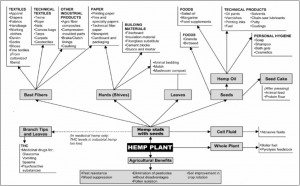
The global market for hemp consists of more than 25,000 products in nine submarkets: agriculture, textiles, recycling, automotive, furniture, food and beverages, paper, construction materials, and personal care.
A 2016 study notes that the most promising markets for North American hemp production is a continued focus on oilseed production and cannabidiol (CBD), a non-intoxicant cannabinoid that has promise for its therapeutic use as a pharmaceutical product.[5]
Figure 1. Modern Uses for Industrial Hemp
Hemp was widely grown in the United States from the colonial period into the mid-1800s. Fine and coarse fabrics, twine, and paper from hemp were in common use. By the 1890s, labor-saving machinery for harvesting cotton made the latter more competitive as a source of fabric for clothing, and the demand for coarse natural fibers was met increasingly by imports. Industrial hemp was handled in the same way as any other farm commodity in that USDA compiled statistics and published crop reports[7] and provided assistance to farmers promoting production and distribution.[8] In the early 1900s, hemp continued to be grown, and USDA researchers continued to publish information related to hemp production and also reported on hemp’s potential for use in textiles and in paper manufacturing.[9] Several hemp advocacy groups, including HIA and Vote Hemp, Inc., have compiled other historical information and have copies of original source documents.[10]
Between 1914 and 1933, in an effort to stem the use of Cannabis flowers and leaves for their psychotropic effects, 33 states passed laws restricting legal production to medicinal and industrial purposes only.[11] The 1937 Marihuana Tax Act defined hemp as a narcotic drug, requiring that farmers growing hemp hold a federal registration and special tax stamp, effectively limiting further production expansion.
In 1943, U.S. hemp production reached more than 150 million pounds (140.7 million pounds hemp fiber; 10.7 million pound hemp seed) on 146,200 harvested acres. This compared to pre-war production levels of about 1 million pounds. After reaching a peak in 1943, production started to decline. By 1948, production had dropped back to 3 million pounds on 2,800 harvested acres, with no recorded production after the late 1950s.[12]
SEED SELECTION AND PLANT DEVELOPMENT
When it comes to macrobiotic CBD oil, there is only one element that has any control over the level of cannabinoids, terpenes, and flavonoids – the plant itself. For this reason, the most important choice any CBD oil company can make involves the sourcing and care of their plants. Unfortunately, many manufacturers take advantage of the minimal regulations and do not disclose that they’re importing cheap plants from growers focusing on quantity over quality.
We grow macrobiotic hemp plants using seeds containing 10% or higher levels of CBD and a THC level of 0.3% or lower. We pre-select plants that are CBD dominant rather than simply extracting whatever cannabinoids happen to be present in a given plant.
The new pioneer Hemp breeders reduced the THC to meet international standards for the definition of hemp, but the CBD was left intact, so that today, Hemp strains are the carriers for the recessive CBD traits that are missing from the Cannabis gene pool. As modern research uncovers the applications for Cannabinoids such as CBD, as a genetic breeder cbd farms.ag is taking a scientific look at Hemp genetics and creating High CBD hybrids that are low in THC. We take High CBD Hemp strains and mix them with traditional Marijuana strains to increase things like flower production, density, structure, and come out with new strains that have all the properties of a medical Marijuana strain, but low enough THC levels to be classified as industrial Hemp. In the most simple way of looking at it, the difference between Hemp and Marijuana comes down to THC and CBD levels with each one potentially carrying high levels of each individual Cannabinoid and low levels of the corresponding one.
For many years, CBD-rich cannabis strains were difficult to come by as the demand for plants as high in THC as possible took the spotlight. Now that the health benefits of CBD are all the rage and people are reporting amazing health results with it, it’s taken a bigger seat in the marijuana growing industry. All of the seeds we will use are carefully selected seed stock or clones, so we already know exactly what to expect before we plant it
Pure CBD oil begins with a macrobiotic CDA-approved seed that is genetically disposed to contain CBD above 10% and THC below 0.3%, the threshold set by the Colorado and North Dakota Department of Agriculture. That’s a low enough level of THC to consume without experiencing any psychoactive effects.
Our seed selection process is ongoing as the industry grows and more CBD-rich strains are developed, so our specialists are always on the lookout for the latest and greatest strains known for high phytocannabinoid production.
Seed selection is only the beginning of our growing process. While a CBD-rich strain is the foundation of any CBD product, the processes used to take that seed from its first sprout to extraction can make or break the potency and purity.
Once one of our seeds is planted, it’s tended to using only macrobiotic farming practices with no pesticides, herbicides, or chemical fertilizers. While there’s nothing we can do beyond our background genetic research and selection to get a plant to produce more CBD once its growing, taking the best care of our plants and keeping them well-fed is how we help maximize the production of plant nutrition and phytocannabinoids present.
In Colorado, around early October when the plant is about 16 weeks old, the flowers are ripe and the hemp is ready to harvest. The exact timeline to harvest can vary from one plant to another, so it’s important to have a close eye on the progress of each plant from day to day during harvest. To top off the strict natural lifestyle our plants enjoy, we also conduct rigorous testing to ensure they’re continuing to produce the levels of cannabinoids we require.
We also take a whole-plant approach to extraction, seeping every ounce of nutrients and value we can get out of the stems, stalks, and seeds.
We have gathered years of research into what goes into GPSI’s end product in order to produce CBD as it should be: unadulterated, potent, and pure.
COMMERCIAL HEMP FARMING
There are many uses for hemp and many methods to farm hemp. We are in the business of producing hemp with high CBD for potential health supplement and, as the pharmaceutical testing is developed, medicinal use. Hemp is also grown for fiber, seed oil, seed for food and bird seed. Hemp seed is a complete food and a great source for protein, fats, carbohydrates, vitamins and minerals. Also the hurd in the stocks can be used for animal feed and bedding. There are many other uses, such as hemp concrete, bio fuels, rope and paper to name a few.
Collective experience of licensed commercial industrial hemp for seed operations in the past several years indicates that industrial hemp is well adapted the Northern Plains and can be commercially grown with current farm equipment. On a large scale operation, industrial hemp can be direct seeded with either a grain drill or an air seeder. No herbicides are labeled for use on hemp, but hemp competes well with weeds. Hemp seed can be harvested with a conventional combine. Cylinder, concave and air settings are similar to those used when combining canola and other small seed crops.
All hemp is referred to as “Industrial Hemp” but growing hemp for CBD is very different than growing it for seed, fiber, paper and bio-fuels. Our plants, grown for CBD, will be grown as bushes with heavy flower filling as many branches as possible. Topping each plant can produce more branches to create more flowers – similar to pinching tomatoes for larger production. Ideally these plants should be 10% + CBD in combination with CBDA, CBG and the other 140+ cannabinoids and 500+ active phyto-chemicals in hemp. We are projecting an overall percentage of CBD in harvested biomass of 7.5%.
In Colorado and North Dakota, all hemp grows need to be registered with the Colorado or North Dakota Department of Agriculture and all hemp plants must be lower than .3% THC dry weight to qualify as hemp. State regulators will do their own sampling and lab evaluation, which we must pay them for. The ratio of THC to CBD is very low in Industrial Hemp and the CBD blunts the effects of the THC – this is why hemp is non-psychoactive. It is critical to have plants that test below the .3% THC levels. If the THC levels are higher we would be required to destroy our entire crop.
Hemp is very efficient in pulling toxins out of the soil. Because of this it is important to have organic or chemical free soils. When the flowers are processed and turned into oil, it condenses and becomes very potent. Any chemicals, herbicides and insecticides will be absorbed and likewise concentrated in the oil. Buyers of hemp oil will run a chemical and residuals panel and will drop the price paid for the oil or flower dramatically if significant chemical content appears. The CBD oil can still be used, but will need to be further refined by distillation to remove the unwanted chemicals – a very labor intensive and expensive process.
Water is essential for keeping our hemp plants healthy. They don’t need huge amounts of water but do need about twenty five inches annually, approximately double the normal annual rainfall for Colorado and North Dakota. Therefore, in Colorado or North Dakota rainfall must be supplemented with irrigation on a constant basis. If our plants become stressed it can drive the THC levels up and possibly over the .3% resulting in a complete loss of the crop. We may utilize various methods in planting including direct seeding, seeding started plants or utilizing started cloned plants to achieve know quality of CBD properties.
There is equipment available to lay plastic mulch for holding moisture in the ground and keeping the weeds down. Commercial Vegetable transplanters can be utilized to plant the clones on a large scale. Ordinary large scale pivot sprinklers can be converted to a make-shift drip system utilizing “Dragon-Line.” Tissue Culture is another avenue we are exploring to replace clone production for internally creating our own quality genetics.
CBD hemp can be a very labor intensive crop, similar to vegetable farming. We are expecting to convert a grain combine in order to strip the plants. Combines will have to be altered to change the way it works to separate the stock from the flower once the plants are dry. There have been stories that combines have been used to harvest hemp but these plants are so tough the machines could get hot and catch on fire. There are various commercial farm machines being built or modified to plant and harvest hemp products
OUR GROWING PROCESS
Most Hemp fields planted in the past have been planted for production of both the seeds of the plant, as well as the stalks which are used for fiber and pulp production. As a result, both male and female plants were allowed to grow in the fields side by side and the males are allowed to pollenate the females resulting in female flowers that are absolutely brimming with seeds. Once a female flower is pollenated, it switches its energy to seed production. When the female plant is allowed to remain un-pollenated, the flowers continue to swell and the plant focuses instead on resin production which is the source of the Cannabinoids contained within Cannabis plants.
Our preferred style of growing Cannabis, known as “Sinsemilla” or without seeds, is the way that illicit marijuana has been traditionally cultivated, in order to maximize the production of Cannabinoids in the plant. Marijuana has not traditionally been grown for its flowers, as its flowers are so low in THC that it has no value in drug culture, so Hemp has wound up being relegated to industrial applications. It was not until recently, with new research into one of the other primary Cannabinoids contained in Cannabis, Cannabidiol (CBD), that Hemp has been looked to as a source of Cannabinoids and not just a source of seeds and stems. And it just so happens we have found that many Hemp strains carry the recessive traits for high CBD production that were lost in Cannabis over the last 50 years as Marijuana was hybridized for its THC content.
Our preferred method of growing Hemp for CBD quality is to grow the plants in the same manner that Marijuana is commonly grown. You see only female plants present with absolutely no male plants allowed, keeping the females perpetually in bud production throughout their entire life cycles. The high CBD strains are typically hybrid crosses of Hemp and Marijuana that are chosen for flower production, so they grow squatter, and less lanky, with less stalk production along with the high CBD trait. This is a brand new approach to growing hemp, where the plant is being grown for CBD production, and not pulp and seed base. Prior to the recent surge of interest in finding a legal source for producing CBD, growing hemp this way would have been unthinkable, there would simply have been no financial incentive for growers to do so. With the current increase in demand for Cannabidiol, and Marijuana’s ongoing legal challenges, low THC industrial Hemp has risen to the forefront as the go to source for legal CBD production, as the Cannabinoids contained within the industrial Hemp plant are considered distinct from Marijuana under U.S. law and are not subject to DEA regulation.
It probably comes as no surprise that if CBD products are being made with plants of an unknown source, this may also mean there are questionable amounts of CBD and other cannabinoids in the product. The Food and Drug Administration confirmed suspicions of questionable claims in 2015 when they conducted a test on various CBD products and found that several contained no traces of CBD at all.
We regularly test our plants to ensure they are the right fit for our products and consumers, and our macrobiotic CBD oils will typically contain 70-80% pure cannabinoids.
There are several solvents that can be used to do this including water, ethanol, propane, hexane, butane, and CO2.
These methods are all generally regarded as safe by the FDA, and chances are we’ve all consumed a product created using one or more of these methods. However, ethanol, propane, hexane, and butane all require introducing foreign substances to the plant, which can either leave residual solvents behind in the finished product or cause damage to the plant waxes, thus affecting the quality and purity.
Butane – Butane is one of the most popular and widely recognized forms of cannabis extraction due to its non-polarity, which keeps it from extracting unnecessary materials beyond cannabinoids. However, butane is highly combustible.
Ethanol – High-grade ethanol can also be used to extract cannabis oil. It’s a popular method used to develop oils used for vape cartridges and concentrates. However, the polarity of ethanol causes it to extract more than just the phytocannabinoids, which clutters up and affects the oil’s purity. In order to separate the CBD the oil has to be winterized, aka soaked in alcohol and frozen until separation occurs.
Olive oil or other cooking oils – Extracting cannabis oil can also be done through olive oil extraction, a common at-home method frequently used by cannabis and CBD home cooks. This is a great method if you’re looking to make a batch of brownies but not practicable for commercial operations.
Supercritical CBD oil CO2 extraction – Supercritical CO2 is a fully recyclable, non-toxic, eco-friendly form of carbon dioxide that’s held at a very specific temperature and pressure to keep it in a liquid state as it passes through the plants. After extraction, the CO2 gasses off entirely from the oil, leaving only plant materials and no residual solvents behind. Supercritical CO2 extraction is the only method that gasses off entirely without requiring harsh chemicals or temperature changes. It is widely regarded as the safest, most eco-friendly way to extract delicate cannabinoids, terpenes, and flavonoids.
Water extraction – Using water to extract CBD oil is the most recent and a very promising high volume method of CBD extraction. It is a clean and environmentally friendly process but entails a high capital cost to build the extraction facility.
~~~~~~~~~~~~~~~~~~~~~~~~~~~~~~~~~~~~~~~~~~~~~~~~~~~~~~~~~~~~~~
Notes:
[1] See, for example, “Purdue University Industrial Hemp Initiative,” NC-FAR Capitol Hill seminar, April 29, 2016.
[2] In this report, cannabis refers to the plant species Cannabis sativa L and all of its industrial, medicinal, and recreational varieties. The terms industrial hemp and hemp are used interchangeably, and the term marijuana (or marihuana) refers to the plant used as a medicinal or recreational drug.
[3] 7 U.S.C. §5940(b)(2). In contrast, marijuana (“marihuana”) is defined at 21 U.S.C. §802.
[4] R. C. Clarke and M. D. Merlin, Cannabis: Evolution and Ethnobotany (Berkeley, CA: University of California Press, 2013). A psychotrophic drug is capable of affecting mental activity, behavior, or perception and may be mood-altering.
[5] J. H. Cherney and E. Small, “Industrial Hemp in North America: Production, Politics, and Potential,” Agronomy, vol. 6, no. 56 (2016).
[6] Nature’s Breakthough, “Hemp’s Potential to Change the World,” at naturesbreakthrough.com/hemps-potential-to-change-the-world. Other hemp product charts include D. G. Kraenzel et al., “Industrial Hemp as an Alternative Crop in North Dakota,” AER-402, North Dakota State University, July 23, 1998; and National Hemp Association, http://nationalhempassociation.org.
[7] See, for example, editions of USDA Agricultural Statistics. A compilation of U.S. government publications is available at www.hempology.org/ALLARTICLES.html.
[8] See, for example, USDA’s 1942 short film “Hemp for Victory” and University of Wisconsin’s Extension Service Special Circular, “What About Growing Hemp,” November 1942.
[9] Regarding papermaking, see L. H. Dewey and J. L. Merrill, “Hemp Hurds as Paper-Making Material,” USDA Bulletin No. 404, October 14, 1916.
[10] See links at http://www.thehia.org/History
[11] R. J. Bonnie and C. H. Whitebread, The Marihuana Conviction: A History of Marihuana Prohibition in the United States (Charlottesville: University Press of Virginia, 1974), p. 51.
[12] USDA Agricultural Statistics, various years through 1949. A summary of data spanning 1931-1945 is available in the 1946 edition. See “Table 391—Hemp Fiber and Hempseed: Acreage, Yield, and Production, United States.”